SaaS Pricing Pages After Google Killed FAQ Rich Results: 3 Changes To Make

Google retired FAQ rich results in 2023. Most SaaS founders never noticed because the old GSC reports kept showing FAQ schema as “valid.” It is. It just stopped doing what it was hired to do. Here are the three changes that matter for a SaaS pricing, comparison, or trial page in 2026.
What actually happened
Google’s announcement on August 8, 2023 narrowed FAQ rich result eligibility to authoritative government and medical institution sites. Search Engine Land confirmed this applies to everyone else, with no exception for high-DR commercial sites. Two and a half years later, most SaaS pricing pages still ship FAQ schema as their primary structured-data investment, even though the dropdown stopped rendering for commercial sites years ago. Validation in GSC keeps the line green, which is exactly why the regression went unnoticed across most growth teams. The playbook needs a rewrite, and pricing pages are where the rewrite pays back fastest.
Why this matters more for SaaS than the average niche
SaaS SEO surfaces have a specific pattern that made FAQ rich results valuable. Bottom-of-funnel SaaS keywords (pricing, comparison, free trial, objection-handling) return SERPs dominated by listicles. “Best CRM for startups.” “ClickUp vs Asana vs Monday.” “How much does Notion cost.” The top three results are almost always G2, Capterra, or a “best of 2026” listicle from a content-marketing site that may not even sell software.
A real SaaS vendor’s pricing page sits at position 5-9. FAQ rich results were one of the few SERP features that helped a single-vendor page expand its vertical real estate enough to reclaim the click from a listicle. That advantage is gone.
In our experience working with SaaS companies between $5M and $50M ARR, the trial-page CTR pattern shifted measurably between Q3 2023 and Q1 2024 when the change rolled through SERPs. Most teams attributed the dip to broader algorithm updates. Some of it was this.
What to change
1. Move FAQ content above the fold, and out of an FAQ block
The point of an FAQ block on a pricing page was always to surface objection-handling content high enough on the page to stay above the fold while keeping the page visually clean. The schema added the SERP bonus. Now the SERP bonus is gone, but the underlying question still applies: how do I surface objections fast for a fast-reading buyer.
Practical pattern that works on pricing pages:
- Pull the top three objections out of the FAQ block
- Render them as sub-headlines next to or below the pricing tiers
- Keep the answer short: one sentence, no more
- Leave the rest in an FAQ block at the bottom for the deep readers
This is not new advice for conversion. It is new advice for a SaaS site that previously relied on FAQ schema to compensate for burying objections.
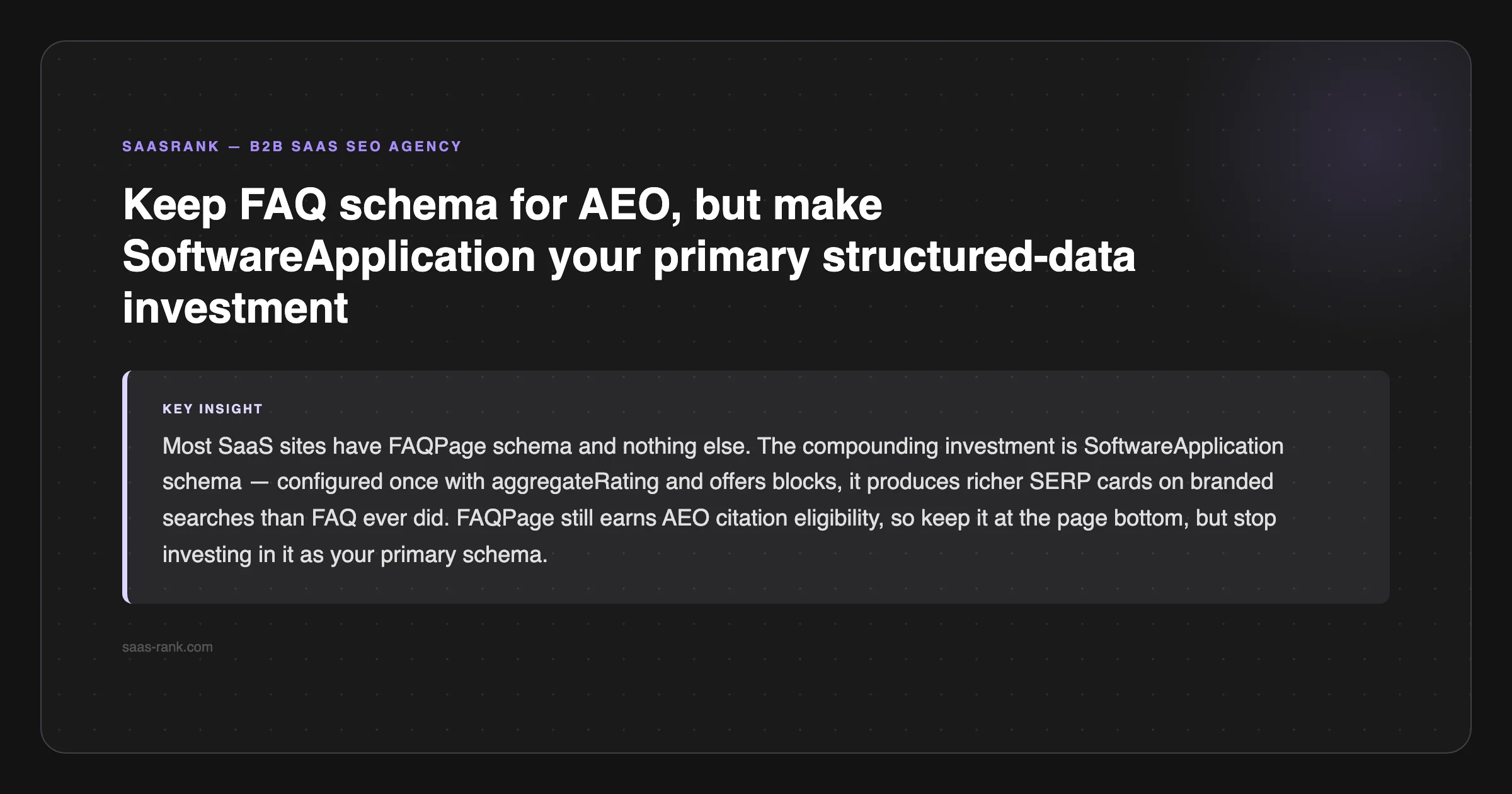
2. Replace FAQPage as the primary schema with SoftwareApplication and Product
SaaS sites have a structured-data option most WordPress-converted sites never use: SoftwareApplication schema with aggregateRating, offers, and applicationCategory. When configured correctly, it produces a richer SERP card on branded and product-name searches than FAQ ever did. The catch is engineering work. You need it rendered server-side, the rating count needs to map to real review data, and the offers block needs to mirror your actual pricing.
| Schema | What it produces in 2026 | SaaS use case |
|---|---|---|
| SoftwareApplication | Star ratings, price, application category in SERP | Product page, pricing page, brand search |
| Product | Price + availability snippet | Pricing tiers as Product entities |
| Organization | Knowledge panel on branded search | Sitewide |
| BreadcrumbList | Clean URL hierarchy in SERP | All pages |
| FAQPage | AEO citation eligibility (no SERP visibility) | Keep at page bottom, do not invest more |
| BlogPosting / Article | Top Stories, news-tab eligibility for content | Blog only |
Most SaaS companies we audit have FAQPage schema and BlogPosting schema and nothing else. The compounding investment is SoftwareApplication, configured once, validated against real product data.
3. Treat comparison pages as a separate problem
Comparison keyword SERPs (“ClickUp vs Asana”) behave differently. Listicle dominance is the structural issue, and FAQ rich results were never going to fix it. The replacement strategy is not schema. It is content structure.
What works on a vendor comparison page in 2026:
- Header: the exact comparison keyword, no clever copy
- A summary verdict in the first 60 words (a real verdict, not “both are great”)
- A feature matrix with at least one cell where your product loses honestly
- A use-case-first recommendation section (“If you are X, pick Y”)
- A pricing-side-by-side block with current numbers, not “varies”
Most B2B SaaS comparison pages we read are written by the vendor’s marketing team and read like sales collateral. The pages that win the ranking read like a procurement analyst’s notes. AI Overviews increasingly cite the second kind. FAQ schema does nothing to change that math.
If your SaaS pricing page is still optimised for SERP features Google retired three years ago, this is the trio of fixes to start with. We cover the broader topic-cluster architecture in our SaaS SEO pillar guide, and we have a deeper post on why generalist SEO agencies fail SaaS clients, where schema misallocation is one of the patterns.
If you want a structured audit of where your SaaS site is still wasting structured-data effort, that is the first thing SaaSRank ships in week one of every engagement.
FAQ
Should I rip out FAQ schema from my pricing page? Stripping it forfeits the cleanest machine-readable signal AI Overviews, ChatGPT, and Perplexity have for matching pricing-page question-answer pairs to a buyer query, which is where citation-driven trial signups now originate for most SaaS vendors. The SERP dropdown is gone, but the AEO surface area is real. Keep the schema and redirect engineering effort elsewhere.
Will adding SoftwareApplication schema actually move rankings? Schema does not move rankings directly. It changes how the SERP renders your result. SoftwareApplication produces a different visual treatment on branded and product-name searches (wider real estate, star ratings, price), which lifts CTR. Rankings move when CTR moves.
Does this affect my blog content too? Tangentially. BlogPosting schema is unaffected. If you have FAQPage schema on individual blog posts as a secondary entity, the same logic applies. Keep it for AEO, but do not expect SERP visibility from it.