Your SaaS Product Is Built for Multiple Markets. Your SEO Strategy Probably Is Not.

SaaS international SEO is how you make your product findable across countries without creating duplicate content or splitting your site’s authority. For most B2B SaaS companies, the answer isn’t country-specific pages. It’s ranking for buyer-intent keywords in English, which already reaches the US, UK, Canada, and Australia simultaneously.
You Already Sell Globally. Your SEO Should Too.

If your SaaS product is sold online, your buyer has no zip code. Someone searching “best project management tool for remote teams” could be in Austin or Auckland. The keyword is the same. The search intent is the same. The content that ranks for it works in every English-speaking market without a single translated page.
This is the part most international SEO guides miss. They assume you need country-specific subfolders, hreflang tags (code that tells Google which language version of your page to show), and localized content from day one. That advice is built for multinational retailers with thousands of SKUs, not for a 30-person B2B SaaS company at $1M-$10M ARR.
The global SaaS market hit $232 billion in 2024. Your share of that doesn’t come from building five country-specific sites. It comes from ranking for the keywords your buyers are already searching, in the language they’re already searching in.
The Multi-Market Trap
Most SaaS founders who think about “international SEO” end up spreading thin across markets and ranking in none of them.
Here’s what that looks like: you create /en-gb/, /de/, and /fr/ subfolders, publish thin versions of the same content in each, and burn 3-6 months of budget producing pages that compete with each other. Google sees five weak signals instead of one strong one. Your competitor, who built 10 pages targeting buyer-intent keywords in English, owns the SERP (the search results page you see when you Google something) while you’re indexing duplicate content across three subfolders.
In our experience, SaaS companies under $10M ARR that try to launch localized content in three markets simultaneously end up ranking in zero. The ones that focus on ranking for their core buyer keywords (without geographic targeting) reach page 1 in 60-90 days on low-competition terms and pick up traffic from multiple English-speaking markets as a side effect.
Why Hreflang Is Not Your First Problem
Every international SEO guide leads with hreflang implementation. That’s backwards for most SaaS companies.
Hreflang tags matter when you have multiple versions of the same page in different languages, like a German version and an English version of your pricing page, for example. But if you’re a B2B SaaS company with one English-language site, hreflang is solving a problem you don’t have yet.
Your first problem is simpler: you don’t rank for the keywords your buyers search. The majority of SaaS keyword searches carry informational intent (buyers researching before they buy). If you’re invisible for those queries, adding a /de/ subfolder won’t fix anything. Ranking for best SaaS onboarding tool in English fixes it, and that one page works in every English-speaking market.
Start with what a SaaS SEO expert actually does: identify the 5-8 buyer-intent keywords your competitors rank for, build content that targets those terms, and earn page-one positions. That’s not domestic SEO. That’s SaaS SEO, and it’s inherently multi-market because your buyers search the same way regardless of where they sit.
Google’s own hreflang documentation confirms that hreflang is for sites with existing multi-language content. Not for sites planning to have it someday.
If You Do Need Country-Specific Pages: Subdirectories
For the minority of SaaS companies that genuinely need localized content (selling into Germany, Japan, or Brazil), use subdirectories (example.com/de/), not subdomains (de.example.com).
Subdomains split your domain authority (a measure of how much Google trusts your website). For a SaaS company with a Domain Rating under 30, that split is fatal. Every backlink, every content signal, every trust marker you’ve built gets diluted across what Google treats as separate sites.
Subdirectories keep everything under one roof. A backlink to your /blog/ post strengthens the entire domain, including your /de/blog/ content when you eventually add it. One domain. One authority score. One compounding asset.
But again, most B2B SaaS companies at $1M-$10M ARR don’t need this yet. English covers your primary markets. The subdirectory conversation becomes relevant when you have paying customers in non-English markets asking for localized content. Not before.
This is one reason why generalist approaches fail SaaS companies. A generalist agency will recommend the same site structure for a SaaS startup as for a multinational retailer. If you’re evaluating partners, here’s how to choose a B2B tech SEO agency that understands the difference.
Rank for Your Buyers First. Geography Follows.
The SaaS international SEO playbook that works at growth stage is simpler than most guides make it:
Step 1 (months 1-3): Rank for your core buyer keywords in English. Target keywords with KD (keyword difficulty, a 0-100 score measuring how hard it is to rank) under 15. Build 10-13 pages of product-led content: feature pages, comparison pages, bottom-of-funnel blog posts (pages targeting buyers ready to act, not just researching). This content works across all English-speaking markets from day one.
Step 2 (months 4-6): Check Google Search Console. You’ll see impressions from countries you didn’t specifically target. A US-focused SaaS product might see 15-20% of impressions coming from the UK or Canada. That tells you where your buyers already are, without any localization effort.
Step 3 (only if needed): If you have real demand from a non-English market (paying customers in Germany, inbound leads from Japan), then build localized subdirectory content for that market. This is a separate project, and most SaaS companies at $1M-$10M ARR don’t reach this stage until year two at the earliest.
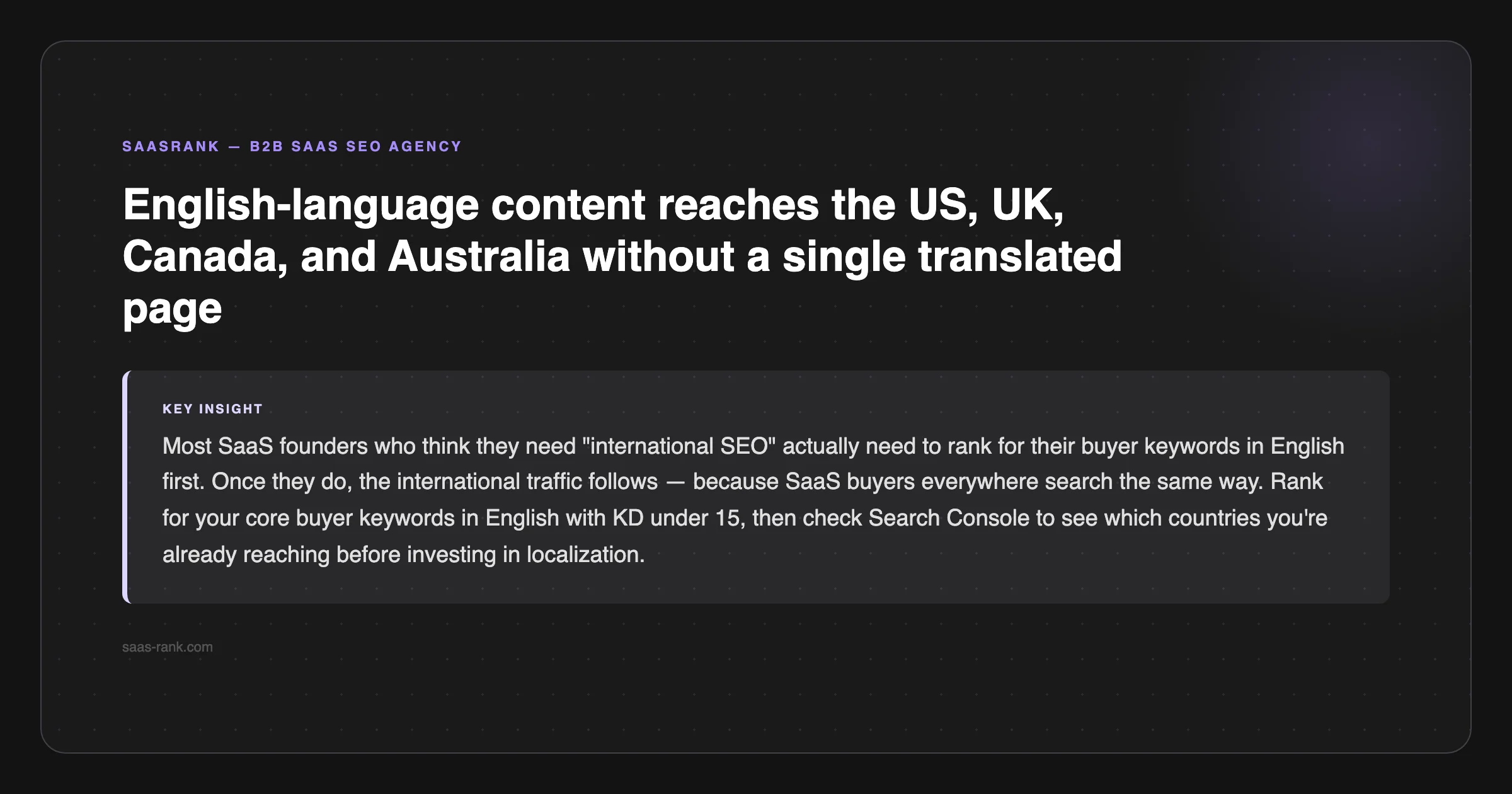
In our experience, most SaaS founders who think they need “international SEO” actually need to rank for their buyer keywords in English. Once they do, the international traffic follows, because SaaS buyers everywhere search the same way.
A boutique SaaS SEO retainer builds exactly this: 10+ pages of product-led content targeting low-competition buyer keywords. No geographic targeting needed. The content works globally because your buyers’ search intent doesn’t have a zip code.
You Probably Don’t Need to Translate Anything
“SaaS onboarding software” has different search volume in the US versus the UK. The spelling differs (optimise vs. optimize). The buyer intent might shift slightly. But the language is English in both markets.
For most B2B SaaS companies at growth stage, the US, UK, Canada, and Australia are all reachable with one English-language site and regional keyword awareness. No translation. No subfolders. No hreflang.
Save your translation budget for the day you have paying customers in a non-English market who are specifically asking for localized content. Until then, every dollar spent on translation is a dollar not spent on ranking for the keywords that drive trial signups today.
FAQ
Should a SaaS company use subdomains or subdirectories for international SEO?
Subdirectories, if you need country-specific pages at all. They keep your domain authority (Google’s trust rating for your website) consolidated under one root domain. But most B2B SaaS companies don’t need country-specific pages. English-language content reaches the US, UK, Canada, and Australia without localization.
How many markets should a SaaS startup target with SEO at once?
Focus on ranking for your buyer-intent keywords, not on geographic markets. SaaS buyers search the same keywords regardless of location. One set of well-built English-language pages covers multiple markets simultaneously. Only create country-specific content when you have real demand from a non-English market.
Do you need translated content for international SaaS SEO?
Not for English-speaking markets. US, UK, Canada, and Australia share a language. You need regional keyword awareness and minor spelling adjustments, not full translation. Translation matters only when expanding into genuinely non-English markets like Germany or Japan, and only when you have existing customers there.