A SaaS Content Marketing Strategy That Produces Customers, Not Just Traffic

A SaaS content marketing strategy is the plan that decides which pages your team writes, which buyer questions they answer, and which pages route the reader toward a trial signup. Most SaaS content strategies fail at the third part. They produce traffic. They don’t produce customers.
Most SaaS Content Marketing Strategies Confuse Traffic With Pipeline

If you ask a SaaS founder how their content is performing, they’ll usually quote a traffic number. “We’re at 12,000 monthly visitors.” That number means almost nothing on its own. The right question is: how many of those visitors signed up for a trial in the same month?
For most SaaS sites under $3M ARR, the answer is between 0% and 0.5%. Twelve thousand visitors produce zero to 60 trial signups depending on how the content was built. The 0% case means the content ranks for the wrong queries. The 0.5% case means the content ranks for buyer-intent queries and routes readers toward the product.
The difference is not luck. It’s strategy. A SaaS content marketing strategy that produces customers starts from the trial signup and works backwards. A strategy that produces traffic starts from “what topics should we write about this quarter?” Those two starting points lead to entirely different content calendars.
We’ve watched founders publish 40 awareness posts before realising none of them feed into a single trial. The cluster ranks. The traffic compounds. The trial signups stay flat. By month 12 the content marketing budget has produced a healthy traffic chart and a flat MRR chart. That’s the failure mode.
The Strategy That Starts From the Trial Signup
A working SaaS content marketing strategy has four layers, in this order.
1. Trial signup intent. Before any content is written, name the three to five buyer queries that signal someone is ready to try a product like yours. Things like “alternatives to [competitor],” “best [category] software for [buyer role],” “[your category] pricing comparison.” These queries have low volume and high intent. They are also where most SaaS sites have no content.
2. Comparison and decision content. Once the trial-intent queries are mapped, build comparison pages and decision-stage content for each one. “X vs Y.” “Alternatives to [competitor].” “Best [category] for [vertical].” These pages convert at 1% to 3% to trial because the reader is already in market. They rank quickly because the SERP is often weak (Reddit threads, outdated G2 listicles, generic listicles from low-authority sites).
3. Educational content that links to the decision pages. Now you can publish “how to” content, but only the kind that links cleanly to your decision pages. A post on “how to forecast SaaS churn” links to your churn analytics product page. A post on “how to onboard new SaaS users” links to your onboarding feature page. Educational content without a path to product is just brand awareness, which has its place but doesn’t drive trial signups.
4. Awareness content, last and small. Awareness content (broad topics, definitions, industry overviews) goes last and stays small. Maybe 20% of the cluster. Most generalist agencies invert this and start with awareness because it’s easier to write. The traffic looks good. The trial chart doesn’t move. This pattern is part of why generalist SEO fails SaaS companies.
Cluster Architecture for a SaaS Content Strategy
A working SaaS content cluster has roughly this shape:
| Layer | Examples | % of cluster |
|---|---|---|
| Trial-intent | ”Alternatives to X,” “Best Y for Z” | 30% |
| Decision | ”X vs Y,” “Pricing comparison” | 25% |
| Educational with product hook | ”How to do X (using Y feature)“ | 25% |
| Awareness | ”What is X,” definitions | 20% |
Compare that to what most SaaS companies actually publish: 80% awareness, 15% educational, 5% decision, 0% trial-intent. The traffic mix matches the publishing mix. So does the conversion rate.
The fix isn’t producing more content. It’s reweighting the mix. A SaaS site with 12 awareness posts earning 8,000 monthly visitors and zero trials would do better with 4 trial-intent pages earning 200 monthly visitors and 4 trials per month. The math is brutal: 4 trials at $300/month ACV is $14,400 in annualised MRR from one quarter of content work. Eight thousand monthly visitors with zero conversions is a free service to your competitor.
This reweighting is the core of what a productized SaaS content strategy retainer ships first. Trial-intent and decision pages get built before awareness, not after.
What This Looks Like at $400K to $3M ARR
At this revenue band, your SaaS content marketing strategy can ship a working cluster in 90 days. Here’s the order:
Days 1 to 14. Map the cluster. Identify three trial-intent queries (KD under 15), three decision queries (KD under 20), and four educational queries that connect to product features. Write the briefs.
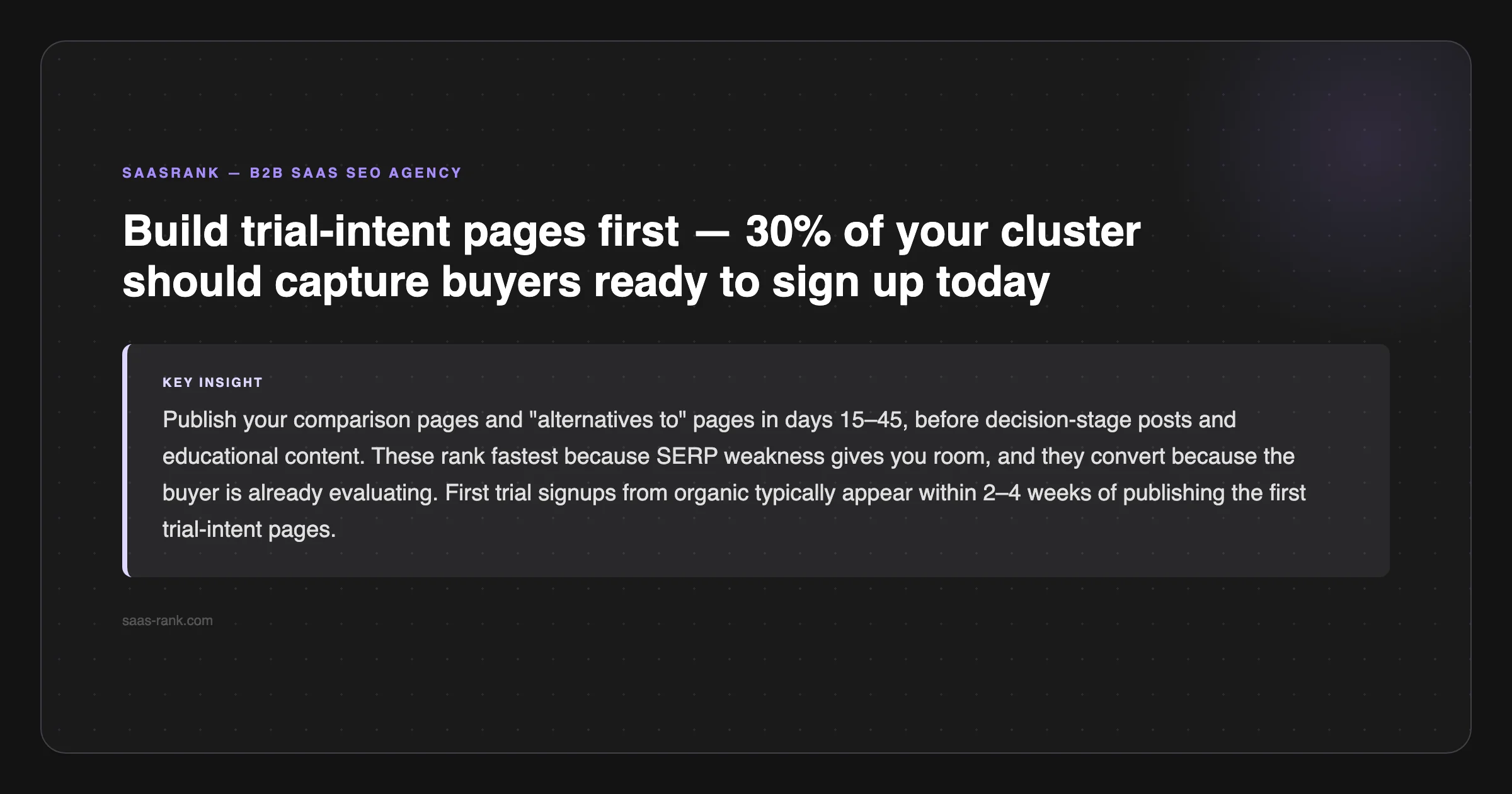
Days 15 to 45. Publish three trial-intent pages first. Comparison pages and “alternatives to” pages. These rank fastest because the SERP weakness gives you room. Schema markup applied (BlogPosting plus FAQPage). Internal links connecting all 10 pages even if not all are written yet.
Days 46 to 75. Publish three decision-stage posts and the pillar guide. Each decision post links into the pillar and out to one trial-intent page. Internal architecture starts compounding.
Days 76 to 90. Publish the four educational posts. Each one links into one of the trial-intent pages with a contextual anchor. Rankings start showing in Search Console for KD 0 to 5 keywords. First trial signups attributed to organic search appear, usually 2 to 4 in the first 30 days post-publish.
That’s 10 pages in 90 days. One practitioner. The whole cluster shipped in roughly the same timeframe a generalist agency takes to deliver the audit document.
What to Cut From a SaaS Content Marketing Strategy
Three things most SaaS content strategies include that don’t earn their keep.
Weekly publishing cadence. Frequency is not the goal. Quality of fit between query and page is the goal. Publishing one excellent comparison page per month beats publishing four mediocre awareness posts.
Lead magnets that don’t tie to product. “10 SaaS metrics every founder should track” as a PDF download produces email addresses, not trials. The email addresses convert at 0.1% to trial. The same effort spent on a comparison page produces more trials.
Webinar and podcast content as primary channels. These work as supplements after a search-led foundation exists. They don’t work as foundations because Google doesn’t rank webinar replays for buyer-intent queries. The minutes you can spend writing a comparison page are more valuable than the minutes spent prepping a webinar at this revenue band.
A boutique SaaS SEO retainer at $750/month builds a content cluster weighted toward trial intent and decision content first. Awareness content is small and last. The whole cluster ships in 90 days. Routes are designed so every page has a path back to product. That’s what produces customers, not just traffic. If you’re picking a partner, the criteria for choosing a B2B tech SEO agency cover the questions to ask before you sign.