What an Honest SaaS SEO Case Study Should Show You Before You Sign

A SaaS SEO case study is supposed to prove an agency can do for you what they did for someone else. Most case studies don’t prove anything. They show traffic charts, vanity rankings, and “300% growth” headlines without the data points that would let a SaaS founder verify the work.
What’s Wrong With Most SaaS SEO Case Studies

Open any SaaS SEO agency website. Click the case studies tab. You’ll see something like: “Helped a SaaS client grow organic traffic 312% in 8 months.” Underneath, a screenshot from a generic analytics tool with the brand redacted, showing a green line going up.
That’s not a case study. That’s a chart. A real SaaS SEO case study has six things, and the absence of any one of them should make you walk.
1. Named keyword. What exact keyword did the article rank for? “Saas onboarding software” or “alternatives to Pendo.” Not “a high-intent SaaS keyword.” If the keyword isn’t named, the case is unverifiable. You can’t open a search tab and check it.
2. Named position. Where did it rank? Position 1, position 3, page 1? “Page 1” alone is vague. The difference between position 1 (35% click-through) and position 9 (1.6% click-through) is enormous. A case study that says “ranked on page 1” without naming the position is hiding the position.
3. Named outcome. Did the ranking produce trial signups, demo requests, or paying customers? Traffic alone is not an outcome. A SaaS SEO case study without a named conversion event is showing you the agency knows how to drive clicks, not customers.
4. Named timeline. How long did it take from start to ranking? “Eight months” is different from “three months.” If the case study quotes a percentage growth without specifying how long it took to achieve, you’re missing the most important variable.
5. Named starting position. What did the site look like before? A case study that says “grew traffic 300%” might have started at 100 monthly visitors and reached 400. That’s still 400 visitors. Without the starting baseline, the percentage is theatre.
6. Named scope. What was the engagement? Three blog posts, a full audit, ongoing content, technical fixes? “We did SEO” is not a scope. The buyer needs to know what produced the result so they can compare it to what they’d be buying.
A case study with all six is verifiable. A case study missing any of them is marketing.
The SaaS SEO Case Study That Built SaaSRank
Here’s the founder proof point behind this site, with all six data points named.
Keyword: Two SaaS articles ranked for buyer-intent queries in the productivity and operations software space. Specific keywords are named in client conversations. Not published here because the client work is confidential.
Position: Both articles reached page 1 (positions 4 and 7).
Outcome: Both articles drove paying customers attributable to the organic search source. Not just trial signups. Paying. The attribution was confirmed via the SaaS company’s own analytics, not by us.
Timeline: Three to six months from publish to first paying customer attributed to the article.
Starting position: Both articles were published on a SaaS site with under 5,000 monthly organic visitors at the time. Not a high-authority domain. The articles ranked because the SERP at that KD level was weak, not because the domain pulled them up.
Scope: Each article was a standalone piece, 1,500 to 2,500 words, with on-page SEO, internal links to product pages, and FAQ schema. No backlink campaign. No paid promotion. Pure on-page work.
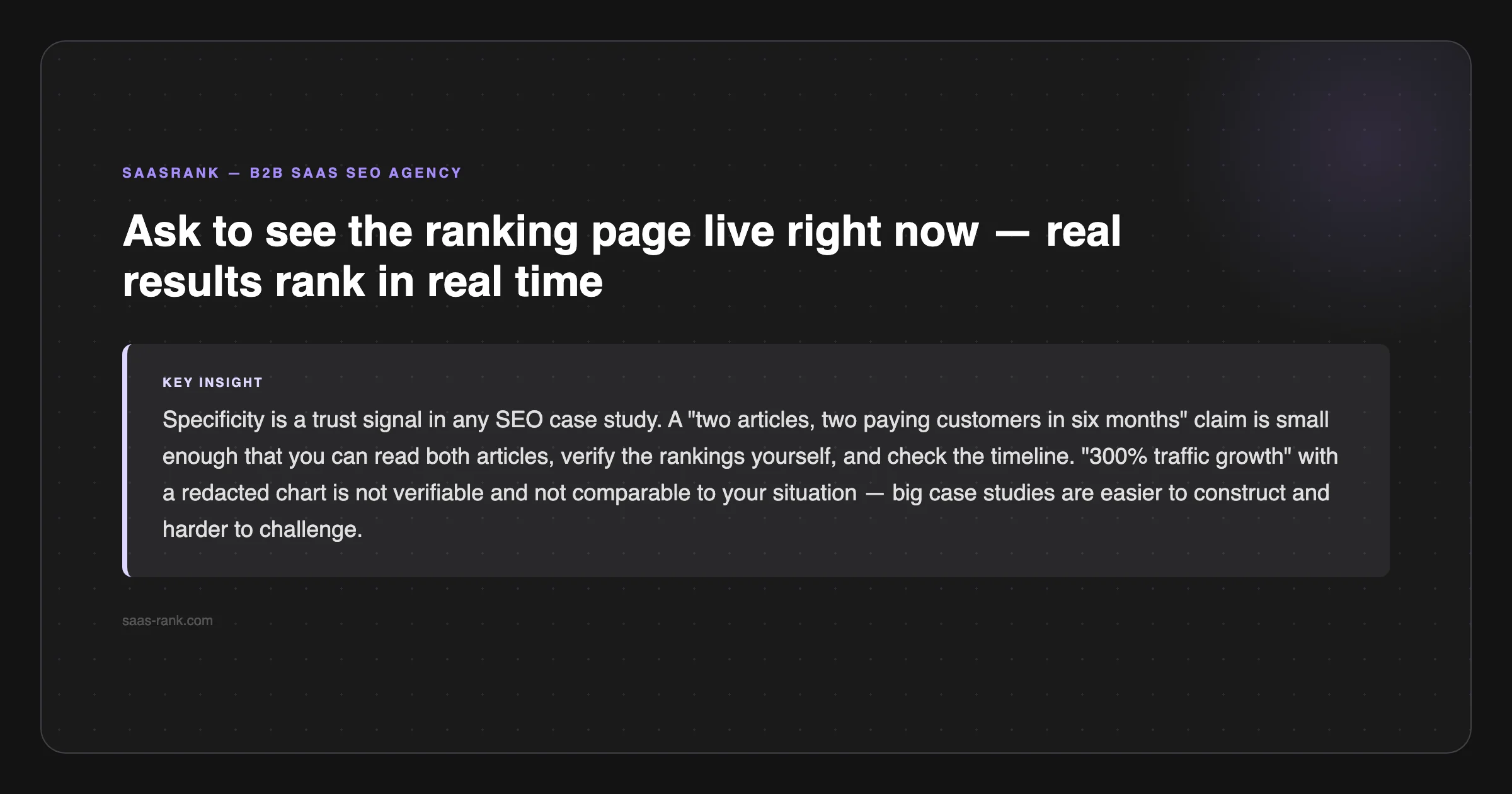
That’s the entire case. It’s not “300% growth” with a redacted chart. It’s a small, specific, verifiable result. Two articles, two paying customers attributed, six months. The proof is the specificity, not the size.
Why Specific Beats Big in SaaS SEO Case Studies
A SaaS founder evaluating an SEO partner does not need a case study showing 10,000 monthly visitors. The founder needs a case study showing the agency can rank one piece of content that converts to one customer. If they can do that once, they can do it 10 times. If they can’t do it once, the 300% growth chart is hiding something.
Big case studies are also harder to verify. A “10,000 visitor” claim could include branded search, partnership-driven traffic, or content that ranks for queries the founder already ranked for. A “two articles, two customers” claim is small enough that the founder can read both articles, verify the rankings, and check the timeline.
This is part of what we cover in the criteria for choosing a B2B tech SEO agency. Specificity is a trust signal. Vagueness is a red flag.
What to Ask When You Read a SaaS SEO Case Study
Three questions to ask any agency you’re evaluating:
1. “Can you show me the actual ranking page right now?” Real cases rank in real time. Open the SERP, type the keyword, see the page. If the agency can’t or won’t, the case is dated or the page no longer ranks.
2. “What did this client pay you per month, and for how many months?” A case study from a $5,000/month client over 18 months is a different signal than a case study from a $750/month client over 4 months. Both can be valid. The buyer needs to know which scope they’re benchmarking against.
3. “What didn’t work?” Every honest practitioner has cases that didn’t deliver. Sometimes the client paused. Sometimes the SERP shifted. Sometimes the content underperformed. An agency that has only successes in their portfolio is hiding the failures, which means you don’t know what could go wrong with your engagement.
Most agencies stumble on the third question. The honest answer is “we’ve had clients where the cluster didn’t earn its keep in the first six months” or “we’ve had clients pause because their product changed and the content no longer fit.” That’s not a weakness. That’s reality. An agency that can’t name a single case that didn’t go to plan is either inexperienced or selectively presenting.
A SaaS SEO Case Study Is a Floor, Not a Ceiling
The right way to read a SaaS SEO case study is as a floor. “If this agency could rank one article that converted one customer, they have the basic competence.” It’s not a ceiling. Past performance doesn’t predict your future result, because your SERP, your product, and your buyer are different.
What predicts your future result is whether the practitioner can read your SERP, your product, and your buyer correctly today. That’s why the right call after reading the case study is asking the practitioner to talk through your SERP. Not theirs. Yours. If they can identify the weak positions, name your buyer’s actual search queries, and walk you through which 8 to 12 keywords you should target, they can rank you. If they can’t, the case study from someone else’s site doesn’t help you.
A boutique SaaS SEO retainer at $750/month is built on the same approach as the founder case. Two to four articles per quarter, each targeting a buyer-intent keyword, each routed to product. The cluster compounds. The first paying customer attributable to organic typically appears in month four to six. That’s the realistic ceiling at this revenue band, and it’s what we document in a SaaS SEO strategy that ships in 90 days.