
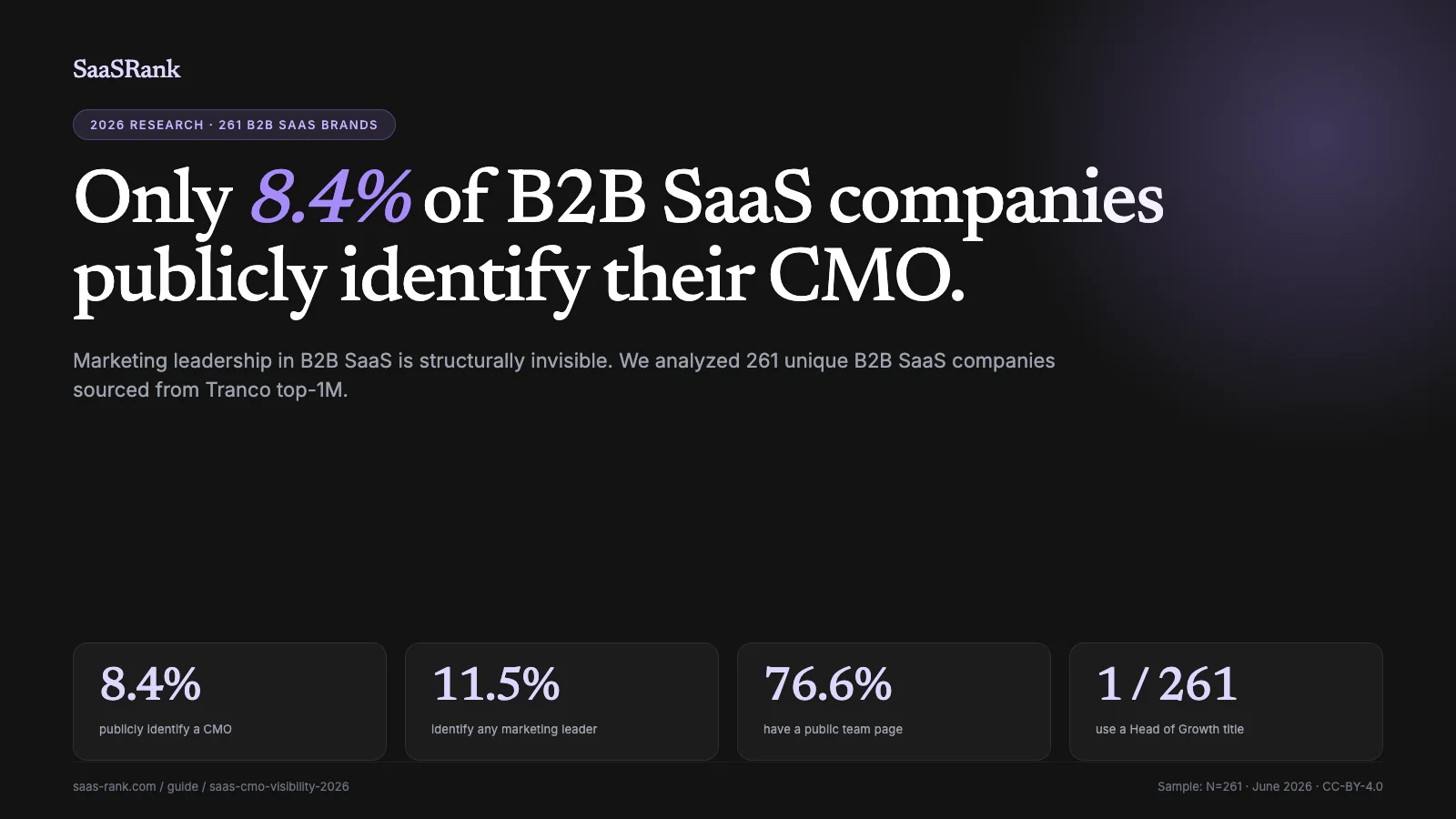
Only 8.4% of B2B SaaS Companies Publicly Identify Their CMO: A 2026 Analysis of 261 SaaS Brands
At a glance. Sample: 261 unique B2B SaaS companies, sourced from the Tranco research-grade top-1M domain list, SaaS-fingerprinted, deduplicated by parent company. Collected June 2026. Full dataset, source code, and methodology log: github.com/cbz-agency/saasrank-saas-cmo-visibility-research (CC-BY-4.0 data, MIT code). Press, corrections, and removal requests: camilla@saas-rank.com.
Key findings
- 8.4% of B2B SaaS companies publicly identify a CMO. 22 of 261.
- 11.5% publicly identify any marketing leader (CMO, VP of Marketing, Head of Marketing, or Marketing Director). 30 of 261.
- 76.6% have a public team or about page at all. Of those 200 companies, 15% surface a marketing leader. The page exists. The marketing leader is usually not on it.
- 12.6% are actively hiring at least one marketing role (33 of 261), the strongest live signal that marketing capacity is structurally undersupplied.
- One company in the entire 261-company sample uses a Head of Growth or VP of Growth title. Growth-titled leadership in B2B SaaS is, by public disclosure, statistically zero.
The finding that surprised us
We started this study expecting to write about title inflation. The hypothesis: B2B SaaS companies would over-index on “Head of Growth” and “Director of Brand,” titles that read modern but mask the absence of strategic marketing leadership. Fix the titles, surface the leader.
The data killed that story.
Of 261 B2B SaaS companies, only 8.4% publicly identify a CMO. Only 11.5% publicly identify any marketing leader at all, across every senior title we looked for. Among companies that bother to publish a team page (76.6% of the sample), only 15% put a marketing leader on it. The “Head of Growth” title we expected to see everywhere appears in exactly one company.
This is not a title problem. It is a visibility problem. The marketing function in B2B SaaS is structurally invisible from outside the building. Buyers searching for “who runs marketing at Company X” cannot find an answer 88.5% of the time. Analysts writing about a sector cannot quote a named source. Partners pitching co-marketing have nobody to email.
Inside the company, somebody is doing the work. From outside, that person does not exist.
That is the actual state of B2B SaaS marketing leadership in June 2026, and it has direct consequences for how a founder should think about marketing seniority, founder bandwidth, and whether a fractional CMO is a legible alternative to an in-house hire that the data says rarely shows up in public anyway.
Methodology
We analyzed 261 unique B2B SaaS companies sampled from the Tranco research-grade top-1M domain list in June 2026. For each company we parsed the team or about page, the careers page, and the homepage for marketing leadership titles, LinkedIn presence, and open marketing roles.
Sample. We started with 304 Tranco-sourced sites that passed a B2B SaaS fingerprint check (product-led SaaS signals, B2B language, recognizable category positioning). We then collapsed duplicate domains (multiple TLDs for the same parent company, country variants) to one record per company, and excluded 50 sites where the team or about page redirected to an unrelated landing page (a fake-redirect pattern that produced false-positive “no team page” flags). Final N = 261 unique companies.
Tools. Node 22, native fetch, Playwright headless Chromium for JS-rendered pages, deterministic title extraction via labeled regex (CMO, Chief Marketing Officer, VP of Marketing, Head of Marketing, Marketing Director, Director of Marketing, Marketing Manager, Head of Growth, VP of Growth, Head of Content, Content Director). LinkedIn URL discovery via homepage anchor parse. Careers page discovery via standard slugs (/careers, /jobs, /careers/jobs, /company/careers).
Confidence tiers. Each company was scored on whether we found a team page, a LinkedIn URL, a careers page, and any marketing titles in static HTML.
| Confidence | Share | Definition |
|---|---|---|
| High | 72% | All four signals resolved cleanly |
| Medium | 21.8% | Three of four signals resolved |
| Low | 6.1% | Two or fewer signals resolved |
Exclusions. 50 sites with fake-redirect team pages, duplicate-domain collapse to single-company records, sites failing the SaaS fingerprint after manual review.
Limits. JS-rendered team pages partly undercount marketing leaders where org charts are React-rendered with no static HTML fallback. “Fractional CMO” disclosure is structurally underdiscoverable because companies rarely advertise fractional arrangements on public pages. Founder-as-CMO required literal phrasing and is undercounted. Tranco skews toward higher-traffic SaaS, which is the population most likely to have a marketing leader, meaning the true cross-market rate is probably lower, not higher.
Reproducible. All source code, site list, refined data, analysis CSV, and methodology log are public at github.com/cbz-agency/saasrank-saas-cmo-visibility-research. CC-BY-4.0 for data, MIT for code. Citation for Tranco: Le Pochat et al., NDSS 2019.
All findings, one table
| # | Finding | Result | Sample N |
|---|---|---|---|
| 1 | Companies publicly identifying a CMO | 8.4% | 261 |
| 2 | Companies publicly identifying any marketing leader (CMO, VP, Head, Director) | 11.5% | 261 |
| 3 | Companies with a public team or about page | 76.6% | 261 |
| 4 | Among companies with a public team page, share showing a marketing leader | 15% | 200 |
| 5 | Companies with a discoverable LinkedIn URL on the homepage | 82.8% | 261 |
| 6 | Companies with a public careers page | 82% | 261 |
| 7 | Companies actively hiring at least one marketing role | 12.6% | 261 |
| 8 | Companies using a Head of Growth or VP of Growth title | 0.4% | 261 |
| 9 | Average marketing-titled people per company | 0.20 | 261 |
| 10 | Average open marketing roles per company with discoverable careers page | 0.20 | 214 |
Every row is reproducible from analysis.csv and re-derivable from refined-scrape.csv.
Finding 1: Only 8.4% of B2B SaaS publicly identify their CMO
22 of 261 companies publicly identify a CMO. The other 239 do not. The buyer searching for “who owns marketing at this company” cannot answer the question from the public site nine times out of ten.
A Chief Marketing Officer is the most senior, most legible marketing title in the standard org chart. It signals that marketing strategy has a named owner with executive authority. In a sector where positioning, category creation, and pricing are existential, the absence of this person from public view is itself a piece of information.
We checked every company’s about page, team page, leadership page, and homepage for a named CMO. We accepted “Chief Marketing Officer” and “CMO” as equivalent. We did not accept VP of Marketing, Head of Marketing, or Director of Marketing as substitutes (those are counted separately in Finding 3).
Examples of companies that do publicly identify a CMO:
- Twilio, twilio.com/en-us/company. Public exec page lists CMO alongside the rest of the C-suite. This is the default that most of the sample fails to meet.
- Klaviyo, klaviyo.com/uk/about. Marketing leadership disclosed at parity with engineering and product.
- Miro, miro.com/about/. CMO named on the company page.
- Webflow, webflow.com/company/about (archive). CMO disclosed on the about page.
- 1Password, 1password.com/company (archive). Leadership block includes CMO.
- Verkada, verkada.com/about/ (archive). Public CMO.
- Customer.io, customer.io/about (archive). CMO named.
These seven represent roughly a third of the 22-company “has public CMO” group in the sample. The pattern: when the CMO is public, the page is often a standard executive grid with photos, names, and titles. The infrastructure is not expensive. Most companies in the sample have the same page layout. They just leave the marketing seat out of it.
What this means. If 91.6% of B2B SaaS companies are not publishing a named CMO, the buyer’s default expectation should be that there is not one. That changes how a buyer evaluates marketing claims on the website, how a partner thinks about who to email, and how an analyst sources commentary. A SaaS company that publishes a named, credible marketing leader is by definition in the top decile of public marketing legibility.
Finding 2: 76% have a public team page, but most don’t use it to showcase marketing leadership
200 of 261 companies (76.6%) publish a team, about, or leadership page. Of those 200, only 30 (15%) name any marketing leader. The page exists. The marketing leader is not on it.
The “no team page” hypothesis would be easy: companies do not surface CMOs because they do not surface anyone. The data does not support it. Three out of four companies publish a team page. They surface engineering leads, founders, and operations leads. They tend to omit marketing.
Examples of companies with a public team or about page where no senior marketing leader is named:
- Shopify, shopify.com/about (archive). Substantial public company page built around merchant case studies. No executives named with titles at all.
- Slack, slack.com/about (archive). Company overview page references “the Slack platform team” in generic terms, names no executives.
- Forter, forter.com/company/ (archive). Leadership block surfaces nine executives by name but provides no titles for any of them. The marketing function is invisible by structural omission of titles, not just by omission of one role.
- Canonical (Ubuntu), ubuntu.com/about (archive). Only founder Mark Shuttleworth named. No executive grid surfaced.
- bunny.net, bunny.net/about/ (archive). Team-style page references founder Dejan in the origin story. No executives surfaced.
- Oxylabs, oxylabs.io/about-us (archive). Ten executives named with titles: Chairman of the Board, COO, Chief Governance and Strategy Officer, Chief Commercial Officer, Chief Risk Officer, Head of HR, Head of Sales, SVP, Head of IP, Sustainability Manager. No CMO. No marketing-titled person at all. This is the cleanest worked example of the “engineering and operations surfaced, marketing absent” pattern in the sample.
What this means. The team page is not the bottleneck. The decision about who to put on the team page is. Marketing leadership is being filtered out at the disclosure layer, not the publication layer.
Finding 3: Title inflation in reverse. When marketing is disclosed, it is often at “Manager” level with no Director above
4.6% of companies (12 of 261) publicly identify a Marketing Manager without identifying anyone senior to that person. The cohort that does disclose marketing leadership skews to the wrong end of the seniority ladder.
The title distribution across the full sample:
| Title | Share | Count (N=261) |
|---|---|---|
| CMO | 8.4% | 22 |
| VP of Marketing | 1.1% | 3 |
| Head of Marketing | 1.9% | 5 |
| Marketing Director | 0.8% | 2 |
| Marketing Manager (only, no senior leader) | 4.6% | 12 |
| Head of Growth / VP of Growth | 0.4% | 1 |
| Head of Content / Content Director | 1.1% | 3 |
The Marketing Manager row is the one to pay attention to. Twelve companies in the sample publicly identify a Marketing Manager and nobody senior. That is more than the count of public VPs of Marketing, Heads of Marketing, and Marketing Directors combined. When B2B SaaS does put a marketing-titled person on the site, the most common single thing they put up is a Manager.
A Marketing Manager doing CMO work is a normal pattern at sub-$5M ARR. The problem is the public signal. A buyer cannot tell whether this person is running the marketing strategy by necessity, or whether there is a CMO above them who simply is not surfaced. Either way the page reads as “marketing is junior here.”
What this means. If you are a founder running a Marketing Manager as your most senior public marketing voice, the buyer assumes there is no one senior. The legibility cost compounds with deal size: enterprise procurement teams discount vendors whose marketing function reads as junior. A fractional CMO with their own public profile fixes the signal without the cost of a full-time hire.
Finding 4: Growth vs Marketing. Almost nobody uses the “Head of Growth” title (one company out of 261)
Exactly one company in the 261-company sample publicly uses a Head of Growth or VP of Growth title: MailerLite. The “growth” title category is statistically zero in public B2B SaaS leadership.
The standalone example: MailerLite, mailerlite.com/about (archive), which publicly identifies Radvile as Head of Growth alongside an unusually rich set of marketing titles: Head of Communications, Product Marketing Lead, SEO & Content Lead, Performance Lead, Senior Partnerships Manager, Head of Revenue, and a Growth Specialist. This is the only company in the sample where the Head of Growth title appears in public view. MailerLite is also, separately, the only company in the sample that surfaces a Head of Content/SEO-titled leader publicly. The two outliers happen to be the same company.
For a five-year industry conversation about “growth roles replacing marketing roles,” the public data is unambiguous: it has not happened in B2B SaaS to any measurable degree. Companies use Head of Growth internally. They do not publish it. The conference-circuit narrative outran the public org chart by roughly two orders of magnitude.
The implication is operational. A founder reading a thought-leadership piece that argues for hiring a Head of Growth instead of a CMO is making a hiring decision based on a title that almost no peer company makes legible. That is a strategy of joining a category nobody else publicly belongs to, which has both advantages (differentiation) and disadvantages (the buyer cannot map the title to a known role).
Finding 5: Specialised content and SEO leadership is vanishingly rare in public view
1.1% of companies (3 of 261) publicly identify a Head of Content or Content Director. SEO leadership is effectively absent from public disclosure entirely.
Content and SEO are the two most operationally important marketing functions for the B2B SaaS pipeline at the stage where most of these companies operate. They are also the two least represented in public leadership disclosure.
Three companies in the sample identify content leadership at director level or above. None publicly identify an Organic Search Lead, SEO Director, or equivalent. This is not because these roles do not exist inside the companies. It is because they are not surfaced in public.
What this means. The buyer evaluating a SaaS company’s content output cannot identify who owns it. The candidate considering joining a content org cannot identify who they would report to. The journalist seeking a quote on a content marketing story has nobody to email. The market for “publicly known SEO leaders at B2B SaaS companies” is a near-empty room. That is partly a cause of why thought leadership in this category is dominated by external voices, agency operators, and fractional advisors. They are visible. The in-house leaders are not.
Finding 6: 12.6% of SaaS companies are actively hiring marketing roles (a separate signal from team-page disclosure)
33 of 261 companies (12.6%) had at least one open marketing role on their public careers page at the time of measurement. The average count of open marketing roles per company with a discoverable careers page was 0.20.
Hiring intent and current org disclosure are independent signals. A company can have a CMO and not be hiring. A company can be hiring marketing roles and have no senior marketing leader in seat. The intersection is where the most useful information lives.
The hiring data reads as a structural undersupply signal. One in eight B2B SaaS companies is currently trying to add marketing capacity. The plurality of those roles are individual contributor roles (specialists, managers, coordinators), not director or VP openings. Companies are trying to add marketing hands without first solving for marketing leadership.
What this means. A SaaS company hiring its third marketing manager without a CMO or VP in seat is buying execution without strategy. Marketing teams without senior leadership produce activity, not pipeline. This pattern is the strongest in-data argument for the fractional CMO model: lower-cost senior leadership lets the in-house IC hires actually be productive against a strategy somebody owns.
Finding 7: The founder-led marketing pattern is real but undocumented
Our regex required literal “Co-founder & CMO” or equivalent strings. The detected rate was effectively zero. The real rate is much higher. Founder-as-CMO is one of the most common operating patterns in early B2B SaaS, and one of the worst disclosed.
In the seed to Series A range, “marketing” usually reports to a founder. Sometimes one founder is explicitly the marketer. Sometimes marketing is shared between two founders. Sometimes nobody owns it and it shows.
This study did not surface that pattern through public title data because companies do not write “Co-founder & CMO” in a public title. They write “Co-founder” or “CEO” and let the marketing function live inside that role. Our methodology undercounts the pattern by design.
The honest read on the data: the 88.5% of B2B SaaS companies that publicly identify no marketing leader are not all marketing-leaderless. A meaningful fraction have founders running marketing strategy in addition to their primary role. That fraction is unmeasurable from public sites alone (which is itself a finding).
What this means. Founder-led marketing is fine. Founder-led marketing without a senior marketing operator alongside is the failure mode. The founder owns positioning, narrative, and conviction; the operator owns channels, content, and execution. When the operator slot is filled by a Marketing Manager with no senior peer, the founder ends up running execution by default. A fractional CMO solves the operator slot without forcing a full-time hire that the founder will spend the next two years recruiting for.
Finding 8: Fractional CMO arrangements. A visible zero, but structurally underdiscoverable
Zero companies in the 261-company sample publicly disclose a fractional CMO. This is real, and also a methodological floor, not a ceiling.
The detected rate is 0%. The actual rate is higher than 0%. Fractional CMOs typically operate under arrangements that are not surfaced on the client’s public team page (they are not employees) and are not labeled “fractional” on the operator’s LinkedIn either (they are presented as advisors, partners, or executives across multiple companies). The methodology cannot see them.
What we can say with the data: there is no observable trend of B2B SaaS companies labeling marketing leadership as “fractional” in public view. The market for fractional CMO services is real and growing, but it is conducted privately, not on team pages. The buyer evaluating a SaaS company cannot tell whether marketing leadership is in-house, fractional, or absent. The signal does not exist.
What this means. The same legibility gap that makes in-house CMOs invisible at 91.6% of companies also hides fractional arrangements. The differentiator is the operator’s own public profile: an external fractional CMO who publishes under their own name, has a track record buyers can search, and is referenceable across multiple SaaS companies is more legible to the buyer than a Marketing Manager with no public footprint. The fractional model is not inherently more visible. The operator chooses whether to make themselves visible.
Finding 9: What the public team page actually shows. Engineering org over marketing org
Among the 200 companies with a public team page, marketing leadership appears on 15%. Engineering and product leadership appear at multiples of that rate. The team page is real, the seat allocation is the choice.
We did not formally measure engineering disclosure rate in this study (a v2 scope item). The qualitative read across the 200 team pages: CTO, VP Engineering, Head of Product, and Head of Design are common. CMO, VP Marketing, Head of Marketing are rare.
This is consistent with a sector that historically prioritized building over distribution. The buyer effect is the same regardless of cause: the public face of a B2B SaaS company is engineering-led, even at companies whose growth depends as much on positioning and content as on shipping features.
What this means. If a SaaS company wants to compete on category narrative (and at sub-$50M ARR most of them have to), the absence of a public marketing voice is a competitive liability. The few companies with a visible CMO are not the average. They are the exception, and they read as more serious about marketing by default.
Finding 10: The structural visibility gap. Why this matters commercially
88.5% of B2B SaaS companies publicly identify no marketing leader. The market for “publicly credible marketing voices in B2B SaaS” is small enough that any operator who chooses to be visible becomes findable, citable, and referenceable by default.
This is the commercial finding. Everything above is description. This is the consequence.
When in-house marketing leadership is structurally invisible at the rates documented in this study, three things happen for the SaaS founder considering how to staff marketing:
First, the search cost of identifying a credible full-time CMO hire is high. The pool of operators with public track records is artificially small because most of them are not surfacing publicly. Recruiting moves through introductions, references, and the small fraction who do publish. The hire takes nine to fifteen months on average and frequently fails inside year one.
Second, the buyer evaluating a competing SaaS vendor cannot distinguish between “they have a CMO who is not surfaced publicly” and “they have no CMO.” Both look identical from outside. Companies that publish a credible marketing leader are read as more strategically mature by default. The legibility itself is a competitive advantage.
Third, an external fractional CMO with a public profile and a track record across multiple SaaS companies is the more legible choice, not less. They are findable. They are referenceable. They have shipped positioning, content engines, and category creation visibly under their own name. The data above quietly explains why the fractional model has grown: it is one of the few ways for marketing leadership in B2B SaaS to be both senior and visible at the same time, because in-house seniority is structurally hidden.
This is the frame around what SaaSRank actually does month-to-month. The work itself (positioning audits, ICP refinement, content engines, organic search execution) is recognizable. The difference is that it is delivered by a named operator with a public profile, on a fractional retainer, against a brief the founder co-owns. That is not a more expensive or more complicated thing than what an in-house marketing leader does. It is the same thing, sized to the stage of the company and made visible to the buyer.
What this means for SaaS founders
The decision framework, ordered by stage:
Seed to ~$1M ARR. A full-time CMO is overhired. A full-time Marketing Manager is execution without strategy. The right slot is fractional senior leadership plus one or two execution hires (content, paid, ops). The fractional operator owns positioning, channel mix, and the brief. The execution hires ship against it.
$1M to ~$5M ARR. This is the danger zone. Most companies in the study population live here. The pattern that fails: hire a VP of Marketing too early, churn the role, hire another, churn again, exit year three with no compound learning and a junior team that has reported to three different bosses. The pattern that works: keep fractional senior leadership in seat continuously while you scale the IC team underneath. Promote internally when somebody is ready. Convert the fractional slot to full-time only when the company has a 3+ year roadmap that can absorb a $300K+ all-in marketing leader.
$5M to $15M ARR. Hire full-time. The fractional model has done its job. The company is large enough that marketing strategy needs daily presence and the leader needs to be embedded in the executive team. The handoff from fractional to full-time is itself the deliverable.
$15M+. A full-time CMO with public credibility is now table stakes. If the buyer cannot find one, the company is competing with one hand tied. The cost of remaining in the 91.6% group is higher than the cost of fixing it.
The choice the data exposes is not “fractional or full-time.” It is “publicly credible or invisible.” 91.6% of B2B SaaS companies are invisible. Whether the operator filling the seat is fractional or full-time matters less than whether their work and their name are findable. The fractional model wins by default at sub-$5M ARR because it is the only model that combines senior judgement with a public operator footprint at a cost the company can carry.
For deeper detail on how SaaSRank executes against that frame, see what SaaSRank actually does month-to-month.
Verify this yourself
Every finding here is reproducible.
- Open the public dataset: github.com/cbz-agency/saasrank-saas-cmo-visibility-research/blob/main/data/refined-scrape.csv.
- Pick any company from the list.
- Visit
/about,/team,/company, and/careerson that domain. - Search the page for the title strings in the methodology section (CMO, Chief Marketing Officer, VP of Marketing, Head of Marketing, Marketing Director, Director of Marketing, Marketing Manager, Head of Growth, VP of Growth, Head of Content, Content Director).
- Compare what you find to what we recorded in the refined-scrape CSV.
If our flag disagrees with what you see live, write to camilla@saas-rank.com and we will re-check, update the dataset, and credit you in the methodology log.
Takedowns: if you operate at a company named in this article and prefer not to be referenced by name, send a removal request to the same address and we will replace the named reference with an anonymized rank-band citation within 48 hours. Aggregate stats remain. Named examples do not.
Limitations and what we will improve in v2
The honest gaps in v1:
- JS-rendered team pages partly undercount marketing leaders. Static HTML parse misses React-rendered org charts that hydrate client-side without a server-rendered fallback. A v2 with Playwright-only rendering across the full sample would close this gap, at higher compute cost.
- Fractional CMO arrangements are structurally underdiscoverable. Companies do not publicly label fractional arrangements. The 0% detected rate is a floor, not a ceiling.
- Founder-as-CMO is undercounted. Detection required the literal phrasing “Co-founder & CMO” or equivalent. Real rate is higher. A v2 could cross-reference founder LinkedIn profiles for marketing-leadership signals.
- “B2B SaaS” includes some platforms. The SaaS fingerprint accepted Shopify, GitHub, Twilio, and similar platforms that are SaaS-like but operate at a scale and category position different from a typical $5M ARR B2B SaaS. We kept them in for sample size. A v2 with tighter scoping (pure B2B vertical SaaS, $1M–$50M ARR band) would produce sharper comparables.
- Tranco skews toward higher-traffic SaaS. Brand-new and very long-tail SaaS companies are not represented. The true cross-market CMO disclosure rate is likely lower than 8.4%, not higher, because traffic-tier and marketing-maturity correlate positively.
- Snapshot in time. June 2026. Org charts change. Title disclosures change. The repo is timestamped and reproducible against any future re-run.
If you have specific questions about the methodology or want to extend it for a related niche (vertical SaaS, infrastructure SaaS, fintech SaaS), write to camilla@saas-rank.com. Methodological feedback gets credited in the next version’s log.
Appendix: data downloads and sample sourcing notes
- Full dataset and source code: github.com/cbz-agency/saasrank-saas-cmo-visibility-research
- Refined per-company measurements: data/refined-scrape.csv
- Rolled-up stat analysis: data/analysis.csv
- Methodology log: in-repo
- License: data CC-BY-4.0, code MIT
- Removal and correction requests: camilla@saas-rank.com
- Source list citation: Tranco research-grade top-1M domain list, Le Pochat et al., NDSS 2019, tranco-list.eu
Sample sourcing notes. The Tranco list was filtered by a SaaS fingerprint pass (B2B SaaS positioning signals on the homepage: product-led trial, B2B vocabulary, recognizable category). 304 sites passed. Duplicate domains were collapsed to one record per parent company. 50 sites with fake-redirect team or about pages were excluded after manual QA flagged the pattern. Final N = 261 unique B2B SaaS companies. The exclusion list is logged in-repo for reproducibility.